



FullStory is a behavioral analytics platform built around session replay, automatic event capture and AI summaries.
It fits product, engineering and support teams at mid-size and large companies that want to answer "what went wrong for this user?" across a whole digital product.
For a marketing team that mainly wants heatmaps and recordings to feed A/B test ideas, it is usually more than you need: paid plans are quote-only, and Hotjar or the free Microsoft Clarity cover the basics for much less.
We have not used FullStory ourselves. This review draws on FullStory's own site and help center, the pricing pages of its competitors, and real test results from our database that show the kind of research a replay tool feeds.
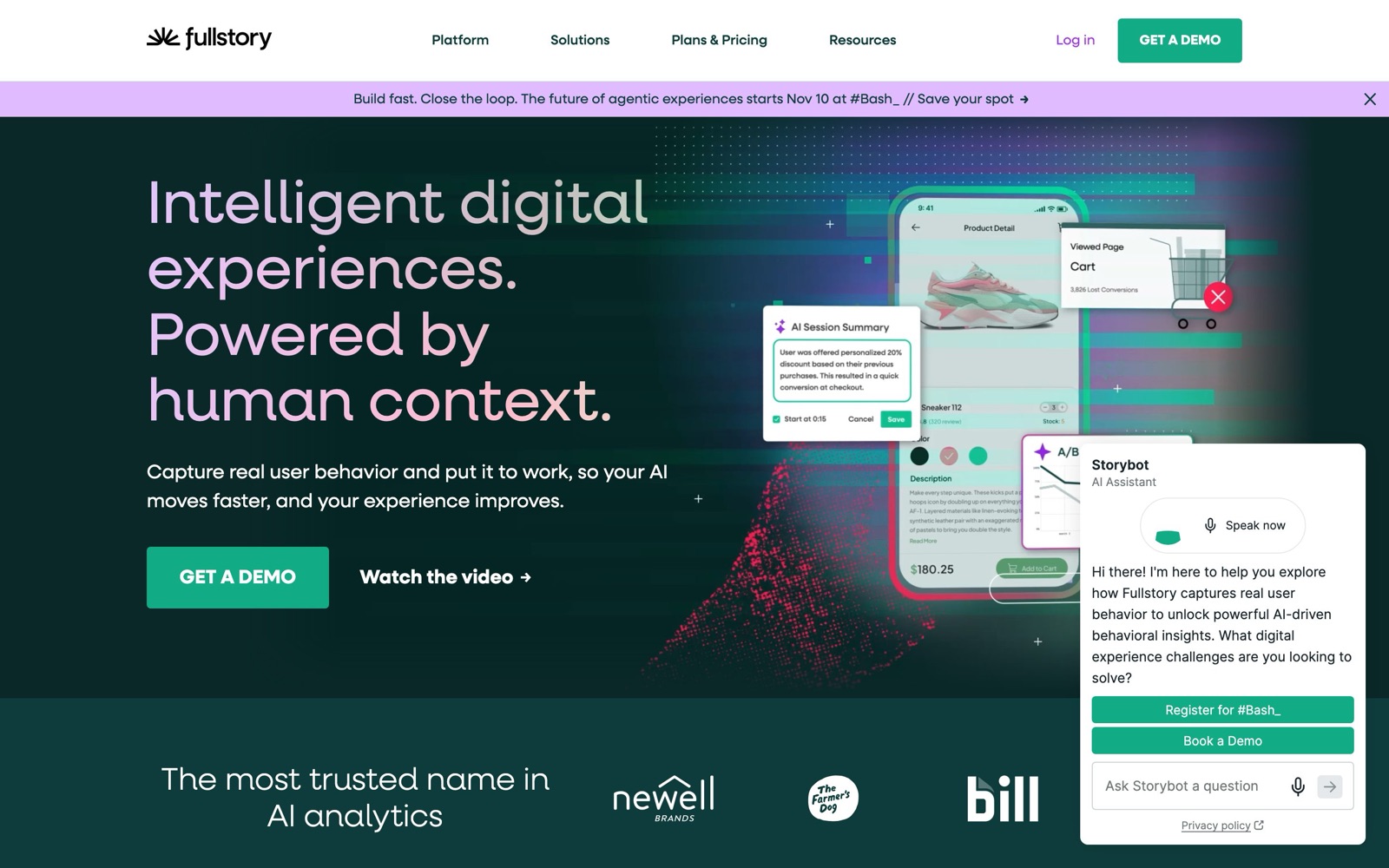
What FullStory does: replay, autocapture and StoryAI
The core is session replay: you watch a recording of a real visit, with clicks, scrolls and form changes.
FullStory records with what it calls tagless autocapture, so you can search past behavior without setting up event tracking for each button in advance.
FullStory also flags frustration signals: rage clicks (rapid repeated clicks), dead clicks (clicks with no effect), error clicks (a click right before a JavaScript error) and thrashed cursor.
For a CRO team, these work as a ready-made list of places where people get stuck.
The plan comparison also lists heatmaps, scroll maps, click maps, conversion maps, funnels, journeys, retention analysis and developer tools.
Mobile analytics and in-app guides and surveys are add-ons.
StoryAI is FullStory's AI layer, which the vendor says runs on Google's Gemini model.
It writes summaries across many sessions, surfaces friction ranked by revenue impact ("Opportunities"), and answers questions about your data in plain language.
On the pricing page, StoryAI is sold as an add-on.
FullStory does not run A/B tests. Its help center describes ways to analyze tests you run elsewhere: filtering by variant URL, using watched elements, or passing the variant ID in as a custom event.
VWO has a native integration, so you can filter replays by VWO test variation and see why a variant won or lost.
FullStory pricing: quote-only, with a limited free plan
As of November 2026, FullStory does not publish prices.
Its plans page lists three Analytics tiers, Business, Advanced and Enterprise, and every one says "Request pricing & demo."
Expect a sales call and an annual contract negotiation, not a credit card checkout.
There is a free tier. According to FullStory's FullstoryFree help article, it includes:
- 30,000 sessions per month
- 10 user seats
- 5,000 server-side events per month
- 1 year of session replay and product analytics retention
The catches are real. The free plan leaves out dashboards, configurable form privacy, mobile apps and StoryAI.
It needs a business email address. Once you hit 30,000 sessions, recording stops until the next cycle.
And under the terms that took effect August 10, 2025, FullStory owns rights to the anonymized, non-PII data collected on free accounts and may use it for AI model training and share it with business partners. Paid customers keep full data ownership.
Strengths for product and support teams
FullStory's best use is debugging and product analytics.
Developer tools, error clicks and live session viewing let an engineer see the exact steps behind a bug report.
Co-browsing and session notes help support teams work through a ticket with the user's real session in front of them.
Autocapture with retroactive data history means you can ask a new question about last month's behavior without waiting for new tracking to collect data.
The paid plans add privacy controls that larger companies need: sensitive data excluded by default, configurable form privacy, IP and location restrictions, and SAML single sign-on.
For CRO, this depth pays off on complex flows.
Checkout and lead forms are where replays tend to show specific, fixable friction, and our database has many tests that started there:
- Removing repeated fields from a quote form lifted completed quote requests by 19.31% in a Qualicorp test credited to VWO.
- Tinkoff Bank added a "Don't remember passport details?" option and saw 35.8% more applications.
- Moving the address step out of checkout gave Ashley Furniture 15% more conversions, in a test credited to AB Tasty.
These tests don't say which research tool was used.
They show the kind of problem replays and frustration signals help you spot before you write a hypothesis.
Weak spots for marketing CRO
Price opacity. Because there is no public pricing, a small ecommerce or lead-gen team can't tell whether FullStory fits its budget without a sales process. Competitors publish self-serve plans.
More platform than you need. Most CRO research comes down to three questions: where do people click, how far do they scroll, and where do they drop off.
Heatmaps and a sample of recordings answer those.
Funnels, retention analysis, data export and AI agents are useful for product teams, but you pay for them whether you use them or not.
Heatmaps are not the focus. FullStory lists click, scroll and conversion maps, but its marketing centers on replay and analytics.
Heatmap-led work is often what drives landing page and product page tests.
Dave Diederen changed above-the-fold USPs to the points heatmaps showed buyers engaging with and got +7.28% revenue per visitor.
Dave also added a countdown timer where heatmaps showed shoppers were focused (+20.65% revenue per visitor) and turned a high-attention collection banner into a clickable timer (+$161K revenue).
A cheaper heatmap tool supports that workflow just as well.
 @DaveDiederen@DaveDiederen@DaveDiederen
No testing built in. You still need a separate A/B testing tool.
Replays explain results; they don't prove that a change caused a lift.
In a sound CRO process, research turns into a hypothesis, and the hypothesis gets tested.
FullStory is not for small stores, solo marketers or anyone who wants to start this week without a sales call.
It also isn't the cheapest way to get heatmaps.
FullStory vs Hotjar
Hotjar is owned by Contentsquare, and hotjar.com's pricing page now redirects to Contentsquare's pricing.
As of November 2026, that page lists a Free plan with up to 200,000 monthly sessions and one month of data access, and a Growth plan from $39 a month billed yearly ($49 billed monthly).
Pro and Enterprise are demo-only. See our Hotjar review for details.
Microsoft Clarity is the free baseline. Microsoft's Clarity FAQ says it is "a free service forever" with no traffic limits.
The trade-off is retention: recordings are kept for 30 days (favorites and a random sample for up to 9 months), and heatmaps for up to 9 months.
| Tool | Main features | Pricing model (as of November 2026) | Best for |
|---|---|---|---|
| FullStory | Session replay, autocapture, frustration signals, product analytics, StoryAI add-on | Quote-only paid plans; free tier with 30,000 sessions/month (plans) | Product, engineering and support teams at larger companies |
| Hotjar (Contentsquare) | Heatmaps, session replay, surveys | Free up to 200k sessions; Growth from $39/month billed yearly (pricing) | Marketing and UX teams that want self-serve plans |
| Microsoft Clarity | Heatmaps, session recordings, AI insights | Free, no traffic limits (FAQ) | Any site that wants heatmaps and replays at no cost |
| Lucky Orange | Heatmaps, session recordings | From $32/month paid annually for 3,500 sessions; 7-day trial (pricing) | Small and mid-size stores |
| PostHog | Product analytics, session replay, feature flags, experiments | Free allowance of 5,000 replays/month, then usage-based (pricing) | Technical teams that want replay and testing in one tool |
In short: choose FullStory if you need deep product analytics, debugging and enterprise privacy controls across a large product.
Choose Hotjar or Clarity if your goal is finding test ideas on marketing pages.
FullStory alternatives
Microsoft Clarity is the first thing to try if budget matters. Read our Clarity review.
Lucky Orange offers heatmaps and recordings with published, session-based pricing.
We may earn a commission if you sign up through our link. More in our Lucky Orange review.
PostHog pairs replay with product analytics, feature flags and experiments, which suits teams that want to test as well as watch. See our PostHog review.
Contentsquare is the enterprise option to compare head to head with FullStory. See our Contentsquare review.
For the full field, see FullStory alternatives and our roundup of session replay tools.
Whatever you pick, replay is one research input among several; our guide to customer research shows how it combines with surveys and interviews to produce hypotheses worth testing.
Then browse real A/B test results to see what similar fixes did for other teams.