




PostHog is an all-in-one product platform for software teams: product analytics, session replay, feature flags, experiments and surveys share one SDK and one free tier.
As of November 2026, the free tier gives every account 1M analytics events, 5,000 session recordings, 1M feature flag requests and 1,500 survey responses each month, with pay-as-you-go pricing above that (PostHog pricing).
Our verdict: PostHog experiments can replace a dedicated A/B testing tool for SaaS and product teams with engineers, but they are a weaker fit for marketers who want a visual editor for landing page and ecommerce tests.
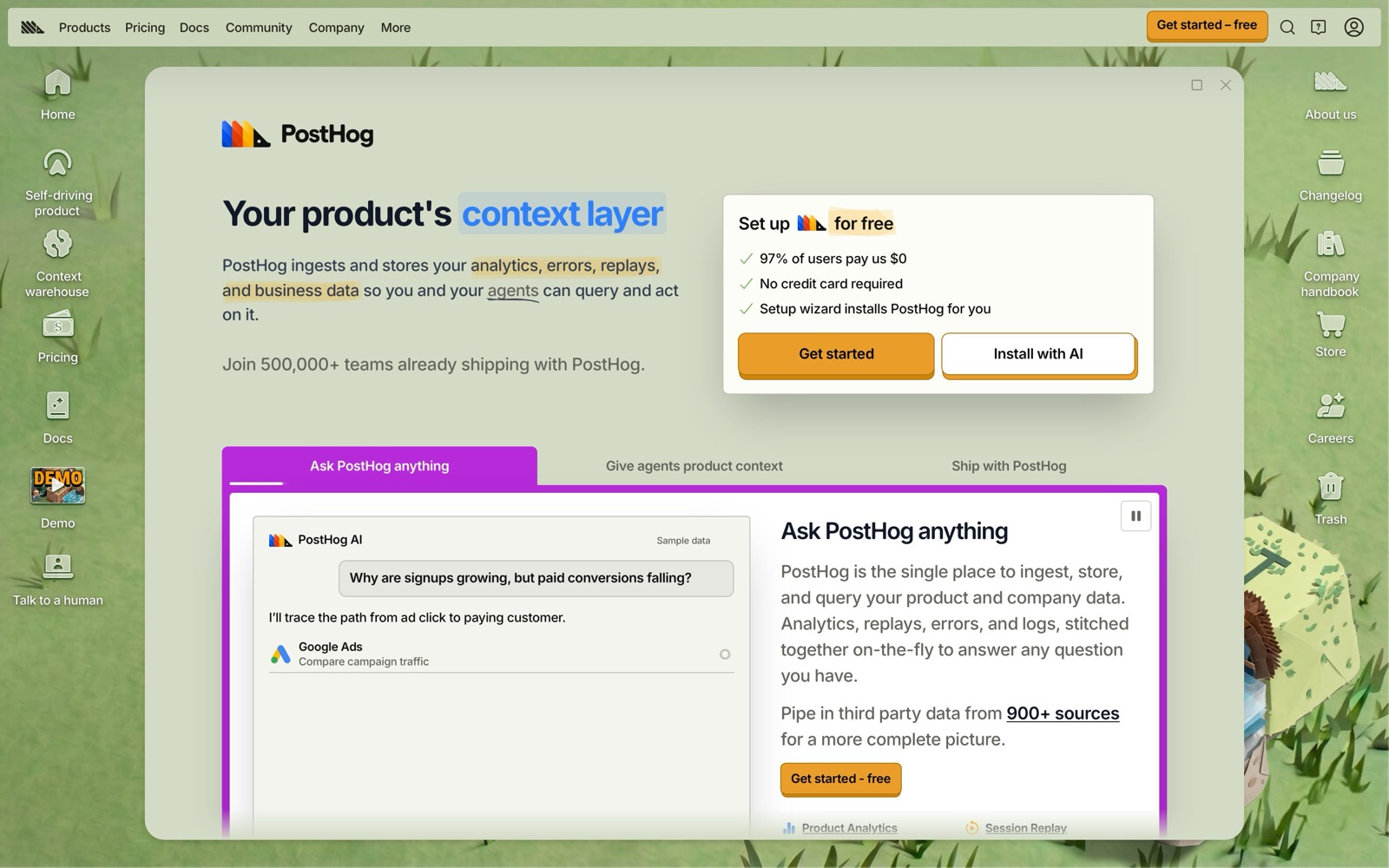
What PostHog bundles: analytics, experiments, flags, replay and surveys
PostHog started as open-source product analytics and has grown into a suite.
The pricing page now lists more than a dozen products, including analytics, session replay, feature flags, experiments, error tracking, surveys, data warehouse sources, logs and AI observability.
For CRO work, five matter most:
- Product analytics: events, funnels, retention and paths. This is the core product.
- Feature flags: turn code on or off for a percentage of users or a segment. Experiments run on top of them.
- Experiments: A/B and multivariate tests measured against any event, funnel or data warehouse table.
- Session replay and heatmaps: recordings of real sessions, plus clickmaps and scrollmaps.
- Surveys: in-app and on-site questions that you can target to specific user groups.
The bundle is the main reason teams pick PostHog.
A variant, its replays, its funnel and its survey answers all live in the same project, so you don't have to stitch tools together.
PostHog is also open source. It offers a free Docker Compose deployment under an MIT license, though self-hosted installs are officially unsupported, so most teams use PostHog Cloud.
PostHog pricing and the free tier
PostHog bills each product by usage, not by seat.
The free allowance resets every month and applies whether or not a card is on file (PostHog pricing, as of November 2026).
| Product | Free each month | Pay-as-you-go starting rate |
|---|---|---|
| Product analytics | 1M events | $0.00005 per anonymous event, $0.000198 per identified event (source) |
| Session replay | 5,000 web recordings, 2,500 mobile recordings | $0.005 per recording, lower at scale (source) |
| Feature flags | 1M requests | $0.0001 per request, lower at scale (source) |
| Experiments | Billed with feature flags | Same as feature flag requests |
| Surveys | 1,500 responses | $0.10 per response, lower at scale (source) |
The free plan has no card requirement and no time limit.
It includes 1 project and 1-year data retention, and usage simply stops at the limits.
On the free plan, extra events are dropped and flags return a default response (pricing FAQ).
Adding a card moves you to pay-as-you-go. You get 6 projects, 7-year event retention and email support, and you can set a billing limit for most products separately.
Recordings are kept for 1 month on the free plan and 90 days on pay-as-you-go (pricing FAQ).
SSO, access control, audit logs and a HIPAA BAA sit in separate Boost, Scale and Enterprise platform packages.
Annual plans and volume discounts go through sales.
Two cost notes. Heatmaps on the free plan cover only 3 pages you choose (heatmaps docs).
And because experiments are billed as flag requests, a busy app that checks flags on every page load can run up flag costs faster than you might expect.
How PostHog experiments work, and their limits for marketing tests
Every PostHog experiment is backed by a feature flag.
The flag randomly assigns users to variants and records exposure, and results come from events you already track (experiments docs).
Metrics can be funnels, means such as revenue per user, ratios or retention.
You can choose either statistics engine. The Bayesian engine reports a chance to win and a 95% credible interval.
The frequentist engine uses t-tests and confidence intervals.
This design is at its best for in-product tests, where an engineer wraps a change in a flag and the metric sits further down the funnel.
These tests from our database are the kind it handles well:
- A floating onboarding checklist in a trial lifted activation by +187%, a test run by AURUM.
- An in-product guided walkthrough in the GoToWebinar free trial produced 2x conversions in Citrix's test.
- Cutting a free trial limit from 15 to 8 cards moved paid conversion from 1.04% to 1.89%, in Patrick McKenzie's test.
Each one changes app logic and measures a product event such as activation or an upgrade.
That is the job PostHog was built for.
 Mida
Marketing-page tests are harder. PostHog does have no-code web experiments built in the toolbar, where you edit an element's text, CSS or HTML.
The docs list their limits themselves: they suit simple changes, they carry more risk for complex edits, and single-page apps built with React, Vue or Angular may overwrite the changes when the page re-renders.
So a copy tweak like Teamleader's "No credit card required" note, which lifted trial sign-ups by +12.5%, fits the toolbar.
So does Mida's sign-up page testimonials test (+56.94% sign-up completion).
A full pricing redesign, like Server Density's packaged pricing tiers (+114% revenue), would usually need an engineer working with flags.
Dedicated tools such as VWO and Convert are built around a visual editor and marketer workflows.
If most of your tests are landing page, product page or checkout changes made without developers, start with our A/B testing tools roundup.
PostHog session replay vs FullStory and Hotjar
PostHog's replay covers web and mobile (iOS, Android, React Native and Flutter), with separate free allowances for each (session replay pricing).
Its strength is the link to everything else: you can filter recordings by experiment variant, funnel step or feature flag.
Heatmaps include clickmaps, scrollmaps, and maps of mouse movement, dead clicks and rage clicks, and heatmap data is free to ingest (heatmaps docs).
The 3-page cap on the free plan is the main catch.
Hotjar is the more marketer-friendly choice for quick heatmaps and on-site feedback without engineering setup.
FullStory goes deeper on digital experience analytics for larger teams and sells mainly through sales.
See our FullStory review, Hotjar alternatives and session replay tools roundup for side-by-side detail.
Replay and surveys are research tools, not tests.
In a sound CRO process they come first: you watch sessions and ask users questions, form a hypothesis, then prove it with an A/B test. Our customer research guide covers that step.
Who PostHog fits, and who it doesn't
Good fit:
- SaaS and app teams with engineers who already ship code behind feature flags.
- Startups that want analytics, replay, flags and tests on one free tier before paying for anything.
- Teams testing onboarding, activation, paywalls and in-app upgrade flows.
- Teams that want open-source code or tight control of their data.
Not a good fit:
- Ecommerce and lead-gen marketers with no developer time, who need a visual editor for many page tests.
- Shopify stores, which are better served by dedicated Shopify A/B testing apps.
- Teams that want a fixed annual price. Usage billing means your bill moves with traffic, so set billing limits from day one.
- Low-traffic sites, where no tool can reach significance quickly. Estimate your required sample size before you commit.
PostHog alternatives
| Tool | Pricing model | Best for |
|---|---|---|
| PostHog | Usage-based, free monthly tier | Product teams that want analytics, flags, tests and replay in one place |
| GrowthBook | Open source plus paid cloud plans | Warehouse-native experiments on data you already have |
| Statsig | Usage-based | High-volume product experimentation |
| VWO | Tiered plans | Marketers running visual website tests |
| Convert | Tiered plans | Agencies and CRO teams running client-side tests |
| Hotjar | Tiered plans | Heatmaps, replay and feedback without engineering |
Pick by who runs your tests. If engineers own experiments and the metrics live in your product, PostHog, GrowthBook or Statsig make sense.
If marketers own them and the metrics are page conversions, a visual testing tool will save time.
For more options, see our PostHog alternatives and experimentation platforms pages.