




Optimizely is an enterprise digital experience platform whose experimentation products let large teams run A/B, multivariate and server-side tests with a sequential stats engine.
It fits companies with high traffic, developers on hand and a five-figure annual budget.
Smaller stores and lean SaaS teams will usually get more out of a cheaper tool like Convert or VWO.
We have not used Optimizely ourselves. This review draws on Optimizely's own docs and pricing pages, plus the customer test results Optimizely has published, which we keep in the LiftArchive test database.
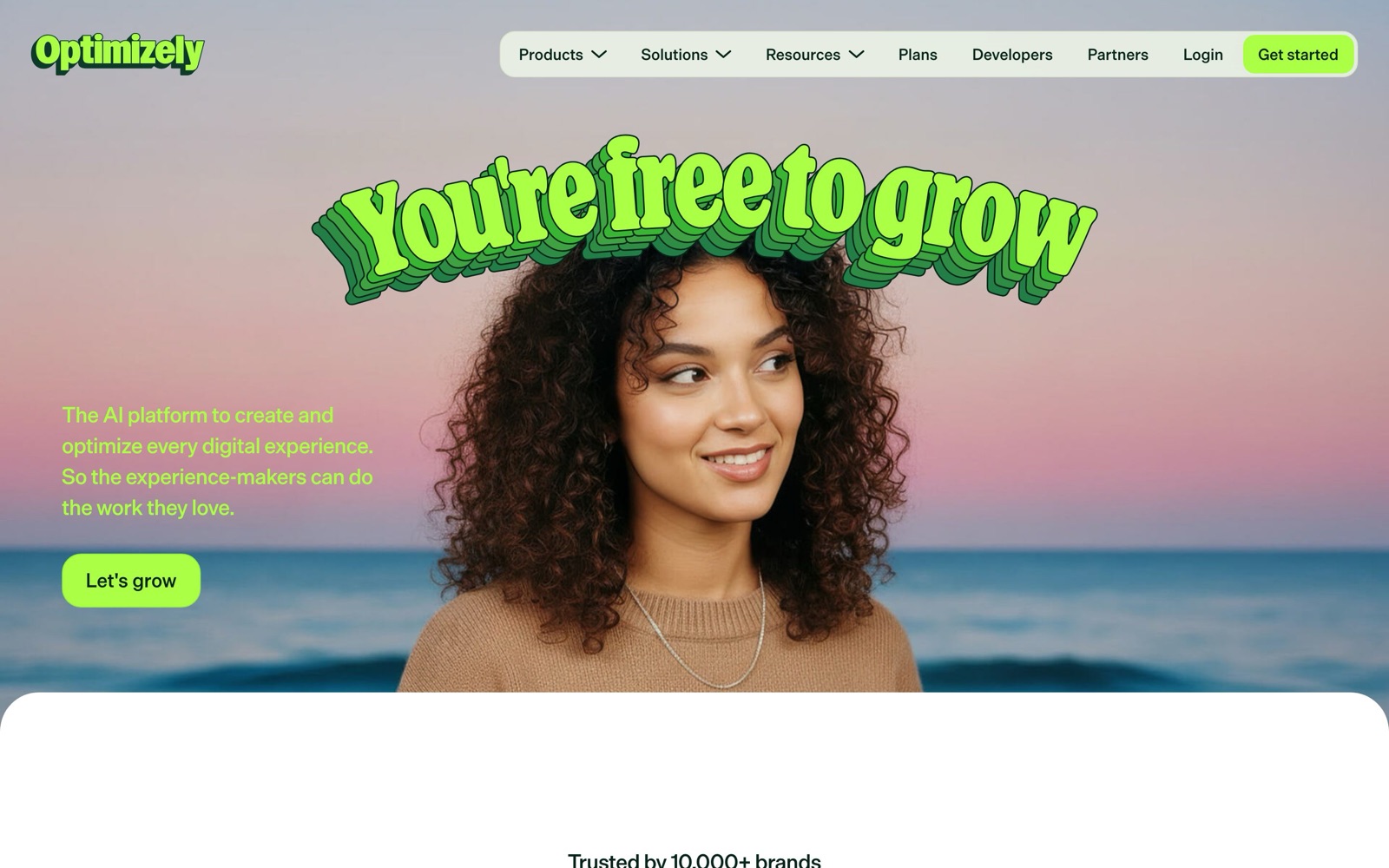
What Optimizely is: Web Experimentation, Feature Experimentation and the wider platform
Optimizely today is more than a testing tool.
Episerver, a Swedish content management vendor, completed its purchase of Optimizely in October 2020 and took the Optimizely name in January 2021.
So the brand now covers a CMS, commerce, a content marketing platform, a data platform, personalization and experimentation, all listed on its plans page.
For CRO work, two products matter:
- Web Experimentation is the client-side tool marketers use. It has a visual editor for changing pages without code, and the product page also mentions server-side control, personalization and AI suggestions for what to test next.
- Feature Experimentation is the developer product. Optimizely's docs describe it as "a feature flagging and experimentation platform" for websites, mobile apps, APIs and other connected software, built on open-source client and server SDKs.
There is a free entry point on the developer side.
The same docs say Optimizely Rollouts, the free plan, includes feature flags and "the ability to run one A/B test."
That is enough to try the SDKs, not to run a testing program.
Optimizely pricing: why there is no public price
As of November 2026, Optimizely does not publish prices.
Its plans page says, "Every Optimizely plan is individually packaged," and routes visitors to a demo request. Expect an annual contract negotiated with sales.
What teams report paying comes only from third parties.
One CRO agency, SplitBase, estimates entry-level plans at about $36,000 a year and says large packages can pass $200,000. SplitBase does not cite named sources for these figures, so treat them as rough market estimates, not quotes.
Because each plan is packaged by hand, the price depends on which products you bundle and how much traffic you test.
Ask sales up front how overage works and whether Web and Feature Experimentation are priced separately.
For comparison, Convert lists its prices as of November 2026: the Growth plan is $299 a month billed annually ($399 month to month) for 100,000 tested users a month, with a 15-day free trial and no card required.
Stats engine and test types
Optimizely's Stats Engine is the main reason teams pick it over cheaper tools.
According to the Stats Engine deep dive, it uses sequential testing with always-valid p-values, so you can check results as they come in without inflating false positives.
It also applies false discovery rate control across all the metrics in an experiment.
The newer A/B results page, available in both Web and Feature Experimentation, lets you pick sequential (the default), fixed-horizon frequentist or Bayesian analysis.
It adds CUPED, which uses pre-experiment data (two weeks by default) to reduce variance so smaller effects show up sooner.
One catch: that page only supports manual A/B experiments, not multivariate tests or Stats Accelerator experiments.
Web Experimentation supports three experiment types:
- A/B and A/B/n tests, comparing two or more versions of a page.
- Multivariate tests, capped at 64 combinations (for example, six sections with two variations each).
- Multi-page (funnel) tests, applying one change consistently across several pages.
It also offers multi-armed bandit optimizations, which shift traffic toward the variation that is converting best.
Optimizely's docs note that bandits do not produce statistical significance, so they suit short promotions better than learning which idea works.
Who Optimizely fits, and who it does not
It fits:
- Enterprises with millions of monthly visitors and a dedicated experimentation team.
- Companies that want marketers testing in the browser and engineers testing behind feature flags, on one platform.
- Businesses already on Optimizely's CMS or commerce products, where adding experimentation keeps one vendor.
- Teams that need governance, many concurrent tests and multiple-metric error control.
It does not fit:
- Small and mid-sized Shopify stores. A contract estimated in the tens of thousands a year is hard to pay back on modest traffic.
- Low-traffic sites. No stats engine fixes a sample that is too small; read our low-traffic testing guide first.
- Teams that want to sign up, pay by card and start the same day. Optimizely is sales-led.
- Developer teams that only want flags and a warehouse-native stats layer, which open-source and lower-cost tools such as GrowthBook or Statsig cover.
The main downsides follow from that: no public pricing, annual commitments, and a broad product suite where you may pay for features you never use.
The tool also does not supply test ideas or traffic.
The program still depends on people doing research and writing good hypotheses.
Real tests run on Optimizely from the database
Optimizely publishes results from its customers' programs, and we keep them in our database credited to Optimizely.
They show the kind of work the platform is built for: large retailers testing search, merchandising and checkout details at scale.
- Removing a membership banner from the cart produced +$5.5M revenue. A small cart change can be worth that much only at very high traffic, which is Optimizely's home ground.
- One size filter above the fold on a footwear collection page lifted revenue per visitor by +2%.
- Recommendations on zero-result searches added +2.74% revenue, the kind of search test that needs developer access to the site.
- Framing a free trial as part of the plan, not an add-on raised enrollment by +37%.
- Not every test wins. A head-to-toe outfits carousel on an apparel homepage had a -6.07% effect on add to cart, which is why you test before shipping.
Notice the size of these effects. Lifts of 2-3% are what mature programs usually find, and detecting them reliably takes large samples.
That is the traffic profile Optimizely's pricing assumes.
 OptimizelyOptimizelyOptimizelyOptimizelyOptimizelyOptimizely
Cheaper options: Convert and VWO
If Optimizely's price or sales process rules it out, two tools cover most of what a CRO program needs from a web testing tool.
Convert publishes its pricing, starting at $299 a month billed annually as of November 2026 on its pricing page, with a free trial.
It works on Shopify and most other sites.
See our Convert review and the head-to-head Convert vs Optimizely.
VWO, now part of Wingify, combines testing with heatmaps and session recordings.
Its pricing page lists Growth, Pro and Enterprise tiers and routes buyers to a demo.
Read our VWO review or Optimizely vs VWO.
We may earn a commission if you sign up for Convert or VWO through our links. It does not change what we recommend.
| Tool | Main strengths | Pricing model (as of November 2026) | Best for |
|---|---|---|---|
| Optimizely | Web and Feature Experimentation, sequential Stats Engine with FDR control, CUPED, Bayesian option, MVT, bandits, CMS and commerce suite | Not published; custom annual plans via sales. Free Rollouts plan for flags and one A/B test | Enterprises with high traffic and engineering support |
| Convert | Client-side A/B, split URL and multivariate testing, works on Shopify | Published; from $299/month billed annually, 15-day free trial | Mid-sized stores and agencies that want enterprise features at a listed price |
| VWO | A/B testing plus heatmaps, recordings and surveys | Growth, Pro and Enterprise tiers; demo-led | Teams that want testing and behavior research in one tool |
For a wider view, see our Optimizely alternatives, the full list of A/B testing tools, our experimentation platforms roundup, and the Adobe Target review for the other main enterprise option.
Verdict
Optimizely is worth its price for enterprises that run many tests on high traffic and need strong statistics, feature flags and governance in one place.
For most stores and growing SaaS companies, the same tests can run on Convert or VWO for a fraction of the cost, and the money saved is better spent on research and test ideas.