


Triple Whale is an attribution and analytics platform for Shopify and other ecommerce brands that spend real money on paid ads and want one place to see which channels drive orders.
It fits brands with steady Meta, Google and TikTok spend that need a better read than the ad platforms give them.
It is not a conversion tool: it tells you where buyers came from, not why they bought, so you still need research and A/B tests to change what converts.
We have not used Triple Whale ourselves. This review draws on Triple Whale's own pricing page and help center, Northbeam's docs, and real tests from our database that show what you do with attribution data once you have it.
If you sign up for Triple Whale through our links we may earn a commission; Triple Whale runs an affiliate program.
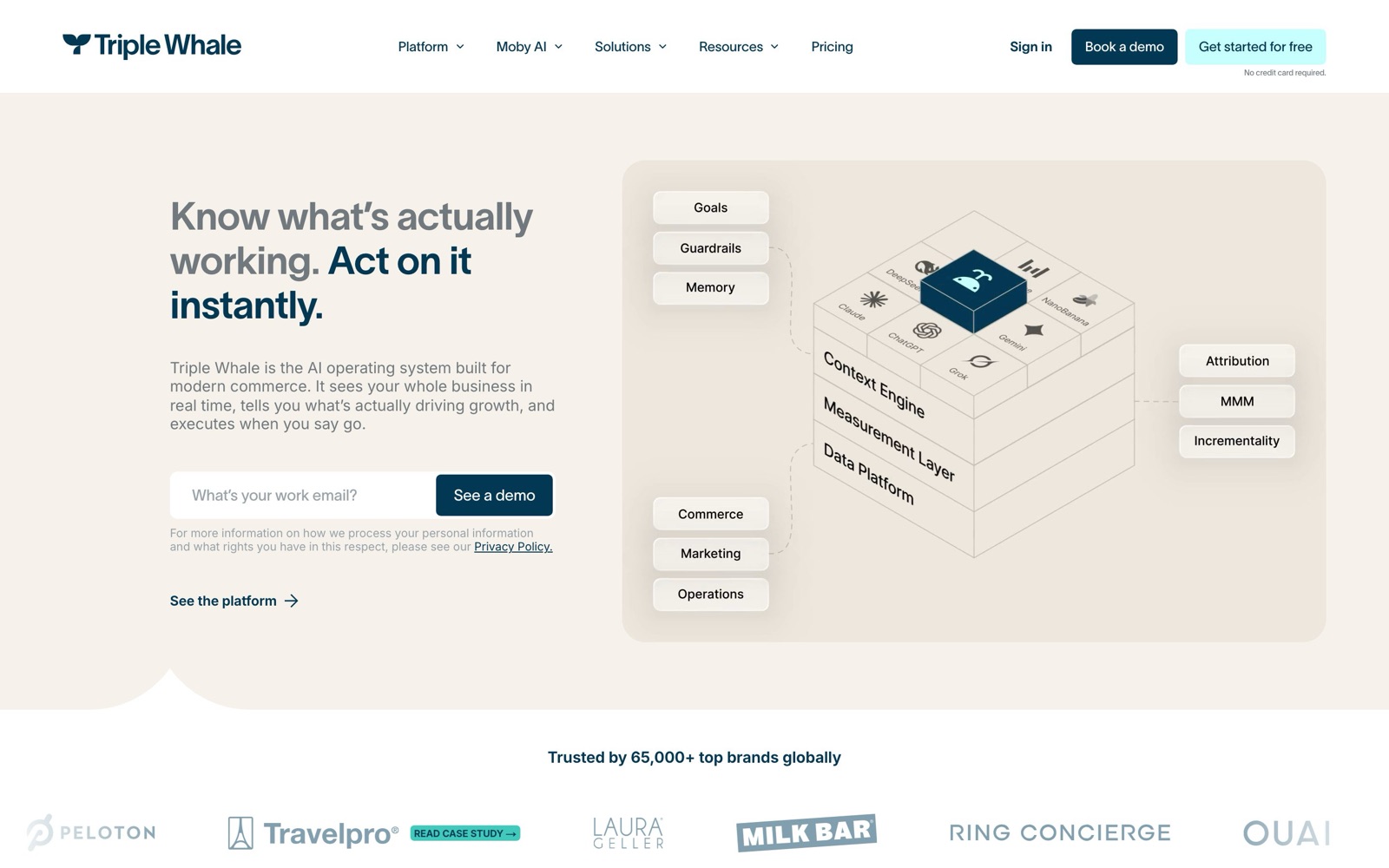
What Triple Whale does: attribution, post-purchase surveys and dashboards
Triple Whale has three main parts that matter for measuring what converts.
- Triple Pixel and attribution. A first-party pixel tracks clicks across the journey and ties them to orders. The help center lists attribution models ranging from first click and last click to linear, Triple Attribution, Clicks & Deterministic Views and Total Impact. The default attribution window is 28 days and you can change it.
- Post-purchase survey. A "How did you hear about us?" style survey on the Shopify Thank you and Order status pages. Per the survey docs, it supports up to 100 questions, follow-up logic, open-ended answers, customer segments and randomized answer order on the attribution question.
- Dashboards and Moby. Paid, owned, subscription and organic data in one view, a BI suite with custom dashboards and a SQL editor on paid plans, and Moby, Triple Whale's AI agent. On the higher plan Moby can run scheduled reports and adjust budgets or pause ads within approval rules, according to the pricing page.
Triple Whale says it is used by more than 60,000 brands.
Triple Whale pricing
As of November 2026, Triple Whale's pricing page lists four packages: Free, Foundation, Automate and Enterprise.
The text of the page doesn't publish fixed dollar amounts.
Prices depend on your annual GMV plus the package you choose, so you get a quote from the calculator or the sales team.
| Plan | What it adds | Price model |
|---|---|---|
| Free | Triple Pixel, first and last click attribution, unified dashboard, basic Moby, AI search visibility tracking | Free, no commitment |
| Foundation | Multi-touch attribution, BI suite with custom dashboards and SQL editor, customer segments, daily Moby | Based on annual GMV |
| Automate | Moby automations and actions, Moby Landing Pages, Creative Studio, full AI model library | Based on annual GMV |
| Enterprise | Compass (attribution, MMM and incrementality together), multi-brand reporting, SSO and audit logs | Based on annual GMV, sold by sales |
Read the contract terms closely. Paid plans are 12-month subscriptions billed monthly or annually, with two months free on annual prepay.
If your revenue grows, Triple Whale moves you to a higher tier, unless you prepaid annually, which locks the tier for the year.
Every paid plan includes unlimited users and multiple stores.
Pixel vs survey attribution
Pixel attribution and post-purchase surveys answer different questions, and good stores use both.
A pixel records what a shopper clicked. It is precise about tracked clicks but blind to things that leave no click: a podcast, a friend's recommendation, a TikTok video watched without tapping, an answer from ChatGPT.
A survey asks the buyer directly. It catches those untracked sources, but people forget, and only some buyers answer.
Triple Whale combines the two. Survey answers get mapped to channels (Instagram answers count toward Facebook, for example), and a survey row appears in the pixel reports.
Its Total Impact model is the only one of its models that uses survey responses to reweight channels, and it needs a connected survey tool and at least 7 days of responses, per the attribution docs.
Without survey data, that model behaves like Linear All.
One caution: in the Triple Attribution models, each platform gets 100% credit for the orders it touched, so attributed revenue across channels can exceed your real sales.
Triple Whale's own docs say not to use it for totals.
Survey data is also customer research, not just attribution.
The objections and reasons buyers type into open-ended answers make strong test hypotheses.
Kasper Dolk added benefit bullets in the hero that answered survey objections and measured +$763,679.14 profit/year.
Oliver Kenyon used survey answers to write three reassurance lines above a collection grid, worth $44,890/month.
If the survey is the main thing you want, a dedicated app like KnoCommerce or Fairing may be cheaper; both connect to Triple Whale.
See our post-purchase survey apps roundup and the customer research guide for how surveys feed hypotheses.
Triple Whale vs Northbeam
Northbeam is the alternative most brands compare. Both sell multi-touch attribution with a first-party pixel, and both now offer a "clicks plus deterministic views" model that adds verified ad impressions from platforms.
The differences are in price transparency, audience and extras.
| Triple Whale | Northbeam | |
|---|---|---|
| Free plan | Yes | No |
| Published price | No fixed price in page text; based on GMV | Starter $1,500/month, Professional $3,500/month; Growth and Enterprise by quote |
| Price driver | Annual GMV plus package | Data volume, measured in pageviews |
| Attribution models | First and last click, linear, Triple Attribution, Total Impact, Clicks & Deterministic Views | Seven models incl. Clicks-Only, Clicks + Modeled Views, Clicks + Deterministic Views |
| Post-purchase survey | Built in | Not a core feature; use a survey app |
| MMM and incrementality | Compass on Enterprise | MMM+ and incrementality add-ons on higher tiers |
| Extras | Moby AI agent, landing pages, creative tools | Media strategist on Professional, Customer Success Manager on Enterprise |
| Best for | Shopify brands wanting attribution, survey and BI in one tool | Brands with larger ad budgets that want attribution-only depth and service |
As of November 2026, Northbeam's pricing page lists Starter at $1,500 per month for brands spending under $1.5M a year, month-to-month on Shopify, and Professional at $3,500 per month on annual terms for teams spending up to $500K a month.
Its attribution docs describe seven models, and its Clicks + Deterministic Views model links platform-verified impressions to conversions.
In short: Triple Whale is the broader, cheaper-to-start tool with a free tier.
Northbeam is narrower, starts at a published $1,500 a month, and puts more weight on attribution modeling and service.
Who Triple Whale fits, and who it doesn't
Triple Whale fits Shopify brands that run paid ads across several platforms, have outgrown last-click reports in Meta and Google, and want attribution, a survey and dashboards without stitching tools together.
It is a weaker fit for:
- Stores with little ad spend. If most sales come from organic or email, the free plan or Shopify's own reports may be enough.
- Teams wanting a short commitment. Paid plans are 12-month subscriptions.
- Anyone who expects attribution to raise conversion rate. It shows which ads and pages bring buyers. You still have to test changes on those pages.
That last point is where attribution earns its cost.
Once you know which traffic converts badly, you can test what it lands on.
Kasper Dolk sent cold ad traffic to a pre-sell bridge page instead of the PDP and cut CAC from €22.10 to €5.37. Peter Christensen launched advertorial-style landing pages for paid traffic and saw -35% CPA at the same spend.
SplitBase's dedicated landing pages for Snow Teeth Whitening showed up to +25% Facebook ROAS.
Dave Diederen matched the social proof line under the add-to-cart button to the ad angle a visitor came from, for +9.74% revenue per visitor.
 @oliverkenyon
 @DaveDiederen
 SplitBase
 @kasper_dolk@kasper_dolk
 @peterac_
Those metrics, CAC, CPA and ROAS, are exactly what an attribution tool reports.
Track them next to conversion rate and revenue per visitor; our ecommerce KPIs guide explains which to watch.
To run the tests themselves, see A/B testing on Shopify.
Triple Whale alternatives
- Northbeam. The closest rival for attribution depth, with published entry pricing and more hands-on service at higher tiers.
- A survey app plus your ad platforms. KnoCommerce or Fairing alongside Meta and Google reporting is a lighter setup for smaller stores. Compare them in KnoCommerce vs Fairing.
- Triple Whale Free. If you are unsure, the free plan gives you the pixel and first and last click attribution with no commitment.
Whatever you pick for attribution, pair it with tools that show what happens on the page and let you test fixes.
Browse the test database for ideas, and read our Shopify CRO guide for where attribution fits in the wider process.