




Statsig is a good fit for SaaS and app product teams that want feature flags, A/B tests and product analytics in one tool, with a free tier big enough to run real experiments.
The catch in 2026 is ownership: OpenAI bought Statsig in 2025, and in May 2026 Amplitude took over the Statsig brand and customers while the founding team stayed at OpenAI.
The product is still strong on statistics, but buyers should weigh that roadmap risk.
This review draws on Statsig's own pricing page and docs, plus public announcements. We have not run Statsig ourselves.
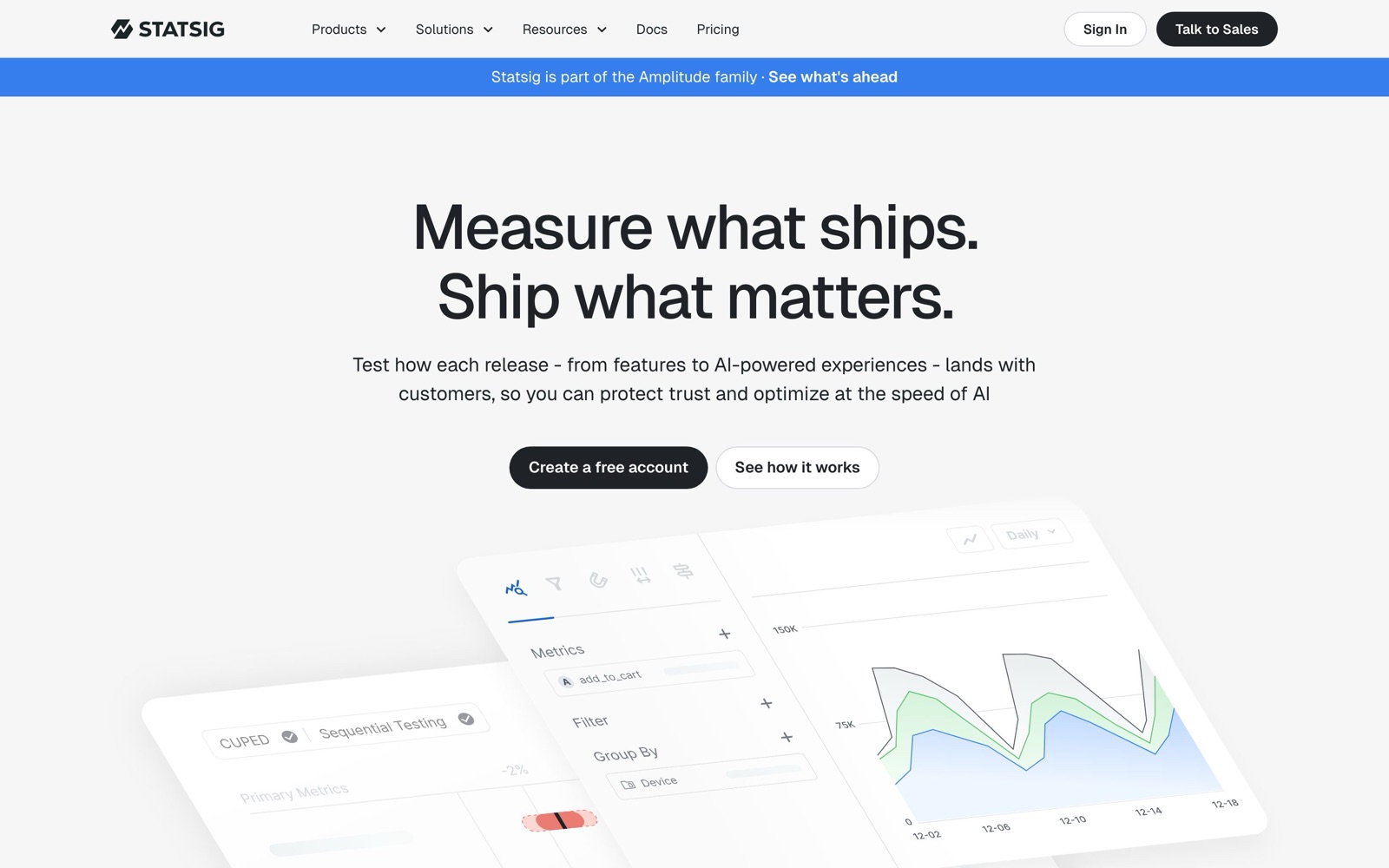
What Statsig does: experiments, feature gates, analytics and session replay
Statsig is a product experimentation platform. Engineers put code behind "feature gates" (Statsig's name for feature flags), roll changes out to a share of users, and turn those rollouts into A/B tests with metrics attached.
The Statsig docs cover SDKs, feature gates, experiments, analytics and Warehouse Native.
On top of that sit product analytics, web analytics and session replay, which records user sessions so you can play them back.
Statsig built replay on the open-source rrweb library and suggests using it to debug bugs, study UX and investigate odd experiment results.
That mix suits tests inside the product, not just on the marketing site.
These are the kinds of tests a SaaS team would gate and measure in Statsig:
- AURUM tested a floating onboarding checklist in a trial and saw +187% activation.
- Acuity Scheduling replaced a free-forever plan with a 14-day Pro trial and got +268% paid sign-ups.
- Server Density moved to packaged pricing tiers instead of per-server pricing for +114% revenue.
- Teamleader added "No credit card required" to trial sign-up for +12.5% sign-ups.
Plan and trial tests like Acuity's change billing logic, so they need a server-side flag and a revenue metric.
That is Statsig's home ground. A visual editor for marketing pages is not its main strength.
More examples sit in our SaaS onboarding tests.
Statsig pricing and the free tier
As of November 2026, Statsig's pricing page lists three plans:
- Developer (free): 2M events a month, unlimited flag and config checks, 50,000 session replays a month, 1-year retention and unlimited seats. A/B tests, feature flags, product analytics and web analytics are included.
- Pro ($150/month): 5M events included, then $0.05 per 1K events, plus 100,000 session replays a month. It adds advanced experimentation, advanced analytics, unlimited retention, change reviews and API controls.
- Enterprise (custom pricing): event- or experiment-based contracts. It adds Warehouse Native, data integrations, SSO, role-based access, teams management, priority support and HIPAA eligibility.
Statsig bills by "metered events": exposures, logged events and ingested or custom metrics.
The pricing page says flag checks on gates at 0% or 100% rollout usually aren't charged.
So pure feature-flag use costs little, while experiment traffic drives the bill.
Unlimited seats on every plan is a real plus for product orgs where PMs, designers and analysts all want access.
Stats engine: CUPED, sequential testing and Warehouse Native
Statistics are where Statsig stands out from most flag tools. Three features matter most.
CUPED variance reduction
CUPED adjusts each user's metric using their behavior before the test.
That cuts noise, so tests can reach a clear result with fewer users.
Statsig Cloud uses a fixed 7-day pre-exposure window, and Warehouse Native lets you set your own.
The docs note CUPED works best on metrics that are stable over time for each user, such as repeat usage.
Sequential testing and Bayesian readouts
Checking results every day inflates false positives. Statsig's sequential testing widens confidence intervals early so you can stop safely when a change is clearly harmful or clearly better.
The docs warn that early lift estimates are noisy, and recommend waiting for the planned sample if you need an accurate effect size.
Bayesian analysis is offered as another option. Either way, size tests first with our sample size calculator.
Warehouse Native
Warehouse Native runs the analysis inside your own data warehouse, so metrics come from the tables your data team already trusts.
It is Enterprise-only. Teams without a warehouse and a data person won't get much from it.
The hosted Cloud version is the normal starting point.
The OpenAI acquisition, Amplitude, and what it means for customers
On September 2, 2025, Statsig announced it was joining OpenAI.
Founder and CEO Vijaye Raji became OpenAI's CTO of Applications.
Press coverage, such as TechCrunch, reported the all-stock deal at about $1.1 billion.
At the time, Statsig told customers it "will continue to provide our services and invest in our core products."
That arrangement didn't last. On May 5, 2026, Amplitude announced it would "take on Statsig's brand and customers" and "maintain and develop the current Statsig platform across the cloud and data warehouse."
Amplitude calls it a strategic partnership. The original Statsig team stays at OpenAI.
Statsig's phase 1 post says Statsig remains a standalone product inside Amplitude, run by a 50-person team.
The stated plan is to link the data layers first, so Amplitude events and cohorts work in Statsig and Statsig results show in Amplitude, with fuller integration after that.
What this means in practice:
- Continuity looks fine for now. The pricing page and free tier are still live, and both companies have committed to supporting existing customers.
- The people who built it are gone. A new team now maintains a complex stats engine. Whether it keeps the old release pace is an open question.
- Amplitude users gain the most. If you already run Amplitude Analytics, the roadmap is pointed at you. If you don't, expect more Amplitude cross-selling over time.
- Read the contract. For multi-year Enterprise deals, ask about price protection and data export terms.
Statsig vs PostHog vs LaunchDarkly
These three overlap but start from different places.
PostHog is an all-in-one product analytics suite. LaunchDarkly is a feature management platform that added experimentation.
Statsig started as an experimentation platform and added analytics.
| Statsig | PostHog | LaunchDarkly | |
|---|---|---|---|
| Core strength | Experiment statistics (CUPED, sequential, Bayesian) | Broad product suite: analytics, replay, flags, experiments, surveys | Feature flag management and release control |
| Free tier (as of November 2026) | 2M events, unlimited flag checks, 50K replays/month | 1M events, 5K recordings, 1M flag requests/month | 5 service connections, 1K client-side MAU, 100K experimentation MAU/month |
| Pricing model | Metered events; Pro from $150/month | Usage-based per product, pay as you go | Per service connection and client-side MAU; Enterprise custom |
| Warehouse-native analysis | Yes (Enterprise) | Not its main model | Not its main model |
| Best for | Product teams running many in-product experiments | Startups wanting one tool for analytics and testing | Engineering orgs where safe releases come first |
Sources: Statsig pricing, PostHog pricing, LaunchDarkly pricing.
Statsig vs PostHog: PostHog's free tier covers more products, and it caps usage at the free limits so you aren't charged by surprise.
Statsig's free tier allows more events and replays, and its stats engine goes deeper.
Pick PostHog if analytics is the main job and you'll test now and then.
Pick Statsig if experiments are the main job.
Our PostHog review covers it in more depth.
Statsig vs LaunchDarkly: LaunchDarkly includes experimentation on all plans, but its pricing and product center on flag management, approvals and release workflows.
Statsig gives you more statistical depth for the money, while LaunchDarkly is the safer choice for large engineering orgs where release governance matters more than analysis.
Statsig alternatives
Statsig is not the right tool for everyone. Skip it if:
- You mainly test landing pages and marketing copy without developers. A visual-editor tool from our A/B testing tools list will be faster.
- You don't have the traffic. Even with CUPED, a SaaS site with a few hundred sign-ups a month will struggle to detect small lifts. Start with customer research to find bigger changes worth testing.
- Ownership changes worry your procurement team.
Strong alternatives:
- GrowthBook: open-source flags and experiments that run on your own warehouse, so you avoid vendor lock-in.
- Eppo: warehouse-native experimentation with a similar focus on statistical rigor.
- PostHog: the all-in-one option. See PostHog alternatives too.
- Optimizely: enterprise web and feature experimentation, with sales-led pricing.
For the full field, see our experimentation platforms roundup, or browse SaaS A/B test results to see what product teams test before you pick a tool.