




Eppo is a warehouse-native experimentation platform for product and data teams that already keep their metrics in Snowflake, BigQuery, Redshift or Databricks.
Datadog bought it in May 2025 and relaunched it as Datadog Experiments in April 2026. It is still a strong pick for engineering-led companies with a data warehouse, especially ones already on Datadog, but it is a poor fit for marketers who want a visual editor or for low-traffic sites.
We have not used Eppo ourselves. This review draws on Datadog's and Eppo's public docs, pricing pages and announcements, plus real tests from our database that show the kind of experiment a platform like this is built to measure.
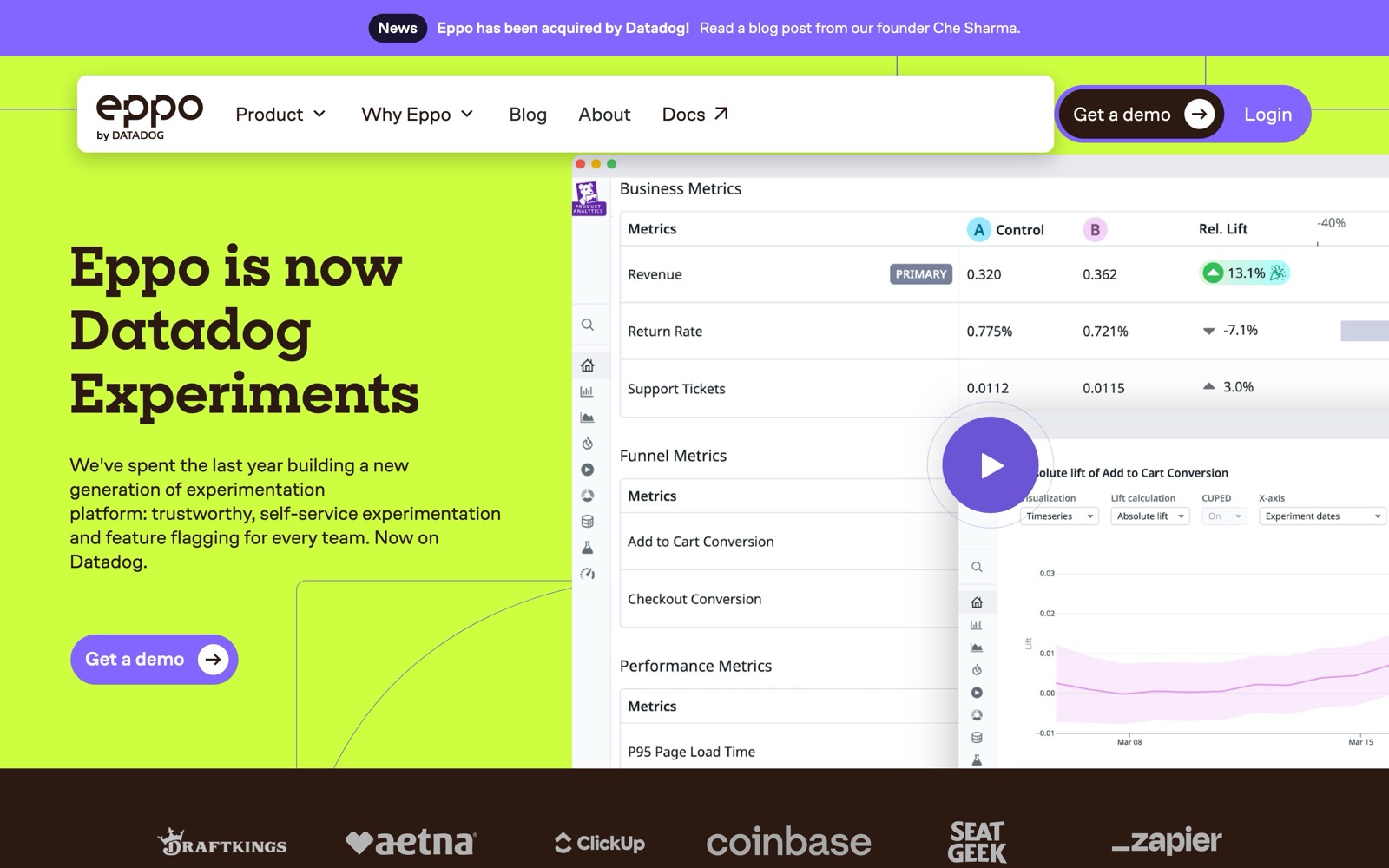
What Eppo is: warehouse-native experiments
Most A/B testing tools collect their own events and compute results on their own servers.
A warehouse-native tool works the other way: it runs the analysis as SQL inside your own data warehouse, against the same tables your finance and analytics teams already trust.
The Eppo homepage, which now says "Eppo is now Datadog Experiments," lists Snowflake, BigQuery, Redshift and Databricks as supported warehouses.
It says the warehouse-native setup avoids moving data out of your environment.
According to the Datadog Experiments docs, an experiment has two parts: assigning users to variants and comparing metrics across them. The parts work like this:
- Assignment: Datadog Feature Flags is the default, using deterministic hashing so users keep the same variant across sessions and devices. You can also bring your own randomization, but then only warehouse metrics work.
- Metrics: computed in your warehouse, from Datadog Product Analytics and RUM events for near real-time client-side results, or from Agent Observability for LLM apps (in preview).
- Statistics: sequential frequentist, fixed-sample frequentist, sequential hybrid and Bayesian analysis, with optional sample size estimates.
The Eppo site also highlights CUPED++ variance reduction and multiple-testing correction.
If those terms are new, our guide to statistical significance explains why they matter.
The kind of test it is built for
Warehouse-native tools are most useful when the result you care about happens well after the click, such as a paid conversion, revenue or activation.
Those numbers usually live in a warehouse, not in a page-level tracker.
A few tests from our database show the type:
- Cutting a free trial from 15 to 8 cards moved paid conversion from 1.04% to 1.89% for Patrick McKenzie's Bingo Card Creator. The win shows up in billing data, not in a click.
- A floating onboarding checklist in a trial gave AURUM +187% activation, an in-product metric defined by what users do after sign-up.
- Packaged pricing tiers instead of per-server pricing brought Server Density +114% revenue. Revenue tests need source-of-truth billing numbers to be trusted.
- Cutting one page from registration gave Encyclopaedia Britannica +117% free trials and +130% revenue, in a test reported by MarketingExperiments. Measuring both numbers at once is the point of tying tests to warehouse metrics.
Not every test wins. Patrick McKenzie's time-limited discount for trial users came in at 1.87% vs 2.08% and was inconclusive.
A platform with sequential testing and sample size planning helps teams call results like that honestly rather than shipping noise.
 MarketingExperiments
The Datadog acquisition
Datadog announced it had acquired Eppo on May 5, 2025.
Press coverage put the price at about $220 million.
Datadog's release said Eppo would keep serving existing customers and signing new ones as "Eppo by Datadog."
Eppo founder and CEO Che Sharma wrote on the Eppo blog that customers would keep the same experience and support.
A September 2025 update said the team was still focused on experimentation and was building error detection, automated canary testing and diagnostics that combine warehouse metrics with app performance data.
On April 2, 2026, Datadog launched Datadog Experiments, built on Eppo's statistics.
It ties experiments to Datadog's RUM, Product Analytics, APM and logs, so one dashboard can show a variant's business impact and whether it slowed the app down.
What this means for buyers:
- Good news: a large public company now backs the product, and Datadog customers get experiments next to the monitoring they already use.
- Trade-off: Eppo is no longer an independent, warehouse-only vendor. The product now lives inside a broad observability suite, and it is priced like one.
- Open question: the public announcements don't give a timeline for moving legacy Eppo accounts to Datadog Experiments. If you are an existing customer, ask your account team directly.
Eppo pricing
Eppo used to sell through sales only. Pricing now runs through Datadog.
As of November 2026, the Datadog price list shows Experiments at $450 per experiment launched per month on an annual commitment, $530 billed month to month and $575 on demand.
Feature flags are billed separately. As of November 2026, Datadog's pricing page says flags are free below 1 million monthly flag configuration requests (MFCRs).
Above that, they cost $55 per million MFCRs on an annual plan, falling to $45 per million above 10 million.
Some things to check before you sign:
- Per-experiment pricing adds up. At the annual rate, running ten experiments in a month would list at $4,500 for that month, before flags or other Datadog products.
- Datadog's other meters. Client-side metrics come from Product Analytics and RUM, which are separate Datadog products with their own usage-based prices.
- Warehouse compute. Warehouse-native analysis runs queries in your Snowflake, BigQuery, Redshift or Databricks account, so you pay for that compute too.
Who Eppo fits (and who it doesn't)
Eppo makes the most sense for:
- Data teams with a warehouse. If metrics such as revenue, retention and activation are already defined in SQL, Eppo can test against those same definitions instead of a second copy in a vendor's tracker.
- Datadog customers. Experiments, flags, RUM and APM in one place means a variant that breaks page speed or raises error rates is easier to spot.
- Product and engineering teams running in-product tests. Think onboarding, pricing and paywall logic, or AI model comparisons. Datadog's launch release positions it for exactly this.
- High-traffic SaaS and consumer apps. Variance reduction helps, but you still need enough users to detect lifts. See choosing A/B test metrics for picking ones that move.
Eppo is not a good fit if:
- You are a marketer testing landing pages and headlines without developers. Eppo has no visual editor in its public docs. A tool from our A/B testing tools roundup will be faster.
- You don't have a warehouse or a data team to define metrics. The Product Analytics route avoids the warehouse, but it ties you into Datadog's other products.
- Your traffic is low. A site with a few hundred conversions a month will struggle to reach significance on any platform. Start with our low-traffic testing guide and customer research to find bigger changes worth testing.
- You want a small, predictable monthly bill. Per-experiment pricing punishes teams that test a lot of small ideas.
Eppo vs Statsig vs GrowthBook
These three are the names that come up most often for warehouse-native testing.
All three have changed hands or business models recently, so check current terms before you commit.
| Eppo (Datadog Experiments) | Statsig | GrowthBook | |
|---|---|---|---|
| Owner | Datadog (since May 2025) | Run by Amplitude since May 2026 | Independent, open source |
| Warehouse-native | Yes: Snowflake, BigQuery, Redshift, Databricks | Yes, on Enterprise plans | Yes, bring your own warehouse on all plans |
| Free option (as of November 2026) | Feature flags free under 1M MFCRs; no free Experiments tier listed | Developer plan: 2M events per month | Free cloud Starter plan (3 users) and free self-hosted open source |
| Pricing model (as of November 2026) | $450 per experiment launched per month, annual | Pro from $150 per month; Enterprise custom | Pro $40 per seat per month; Enterprise custom |
| Best for | Data teams already on Datadog | Product teams that want analytics and experiments in one tool | Teams that want low cost, self-hosting and no lock-in |
Sources: Datadog price list, Statsig pricing, GrowthBook pricing.
Eppo vs Statsig: both put statistical rigor first.
Statsig's pricing page shows a free Developer plan and a $150 Pro plan, but warehouse-native deployment is on Enterprise only.
Eppo was warehouse-native from day one. OpenAI bought Statsig in 2025, and Amplitude took over the Statsig product in May 2026. Read our Statsig review for the details.
Eppo vs GrowthBook: GrowthBook is the low-cost, open-source option.
Its pricing page lists a free self-hosted version and a Pro plan at $40 per seat per month, with CUPED and sequential testing on Pro.
Pick GrowthBook if budget or self-hosting matters most.
Pick Eppo if you want Datadog's support and its link between experiments and app performance. See our GrowthBook review.
Other options to weigh are PostHog for an all-in-one product suite and Optimizely for enterprise web and feature testing.
Our experimentation platforms roundup compares the full field, and our SaaS test results show what product teams test once a platform is in place.