




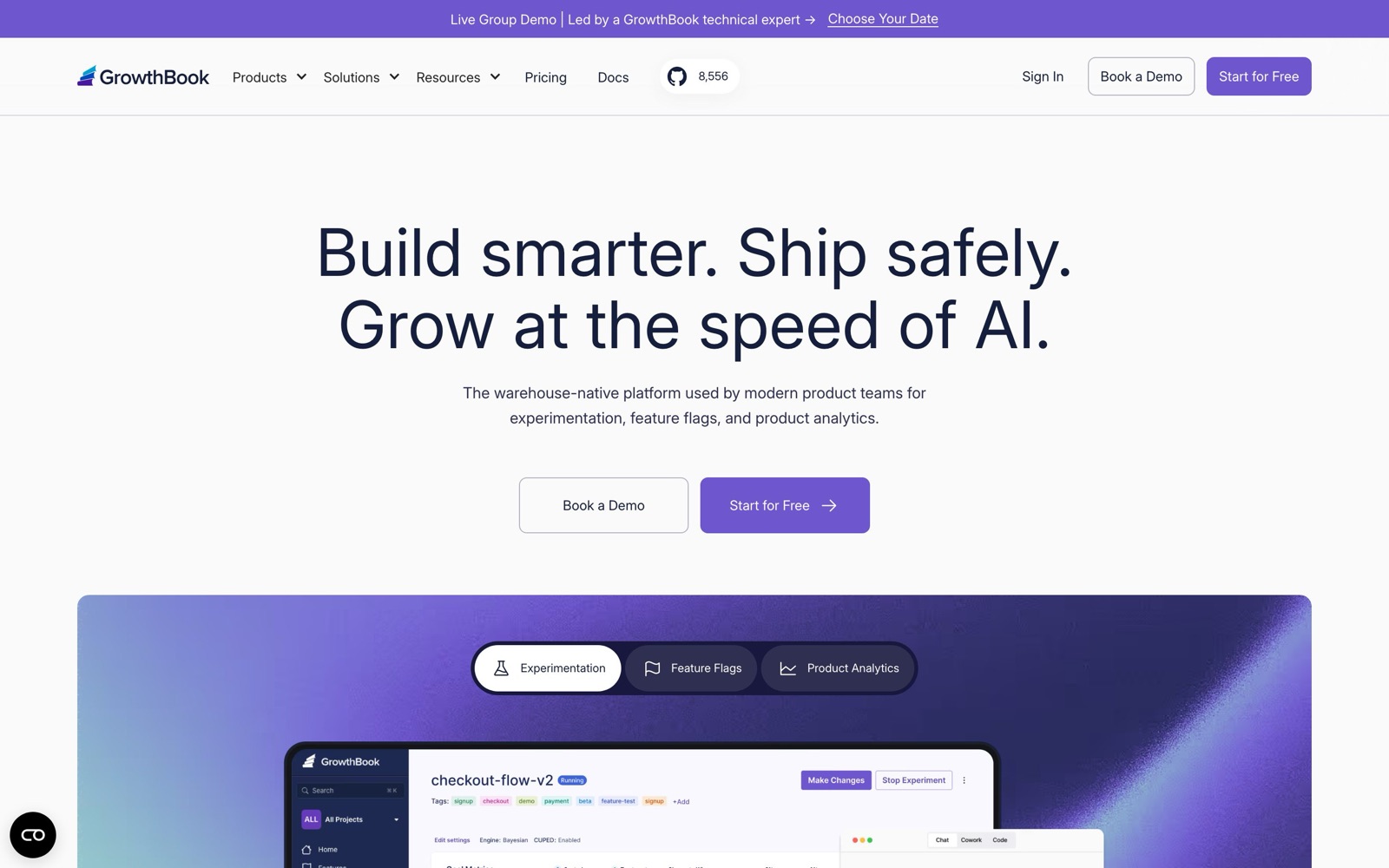
GrowthBook is an open-source feature flagging and A/B testing platform for engineering-led product teams that already keep their data in a warehouse.
Our verdict: it is one of the strongest free alternatives to paid testing tools if you have developers and SQL skills, but marketers who want a polished no-code editor for landing pages will find it a weaker fit.
This review uses GrowthBook's own pricing page, docs and GitHub repository. We have not run GrowthBook ourselves.
What GrowthBook is: open source and warehouse native
GrowthBook combines feature flags and experiments in one tool.
Engineers wrap a change in a flag, roll it out to a share of users, and turn that rollout into an A/B test with metrics attached.
The pricing page lists 24+ SDKs, a REST API and webhooks (GrowthBook pricing).
The code is "open core." Most of it is under the MIT license, and a few directories fall under a separate commercial GrowthBook Enterprise License (GitHub).
So the free version is open source, but some paid features are not.
"Warehouse native" means GrowthBook doesn't need to store your user data.
It runs read-only queries against your warehouse and only receives aggregated statistics (GrowthBook docs).
Supported sources include BigQuery, Snowflake, Databricks, Redshift, ClickHouse, Postgres, MySQL, SQL Server, Athena, Presto/Trino, Vertica and Mixpanel.
That setup matters most when the metric you care about lives in your own data, not in a page-view tracker.
A few tests from our database show the kind of work this suits:
- AURUM added an onboarding checklist and got +187% activation. Activation is a product event, measured inside the app.
- Server Density switched to packaged pricing and saw +114% revenue. A test like that changes billing logic, so it needs a server-side flag.
- Zumba tested a web checkout button in its app paywall: immediate conversions fell 25%, but LTV rose 17%. Judging it on the first metric alone would have picked the wrong winner.
- BuyBye raised its yearly price by 50%: conversions dropped 19%, but proceeds per user rose 25%.
The last two are the strongest case for a warehouse-native tool.
If revenue, refunds and lifetime value already sit in your warehouse, GrowthBook can use them as experiment metrics without a second tracking setup.
Our price testing guide covers how to run tests like these safely.
Self-hosted vs cloud, and GrowthBook pricing
GrowthBook offers both a hosted cloud and a self-hosted version.
As of November 2026, the pricing page lists these plans:
- Cloud Starter (free): up to 3 users and 1 project, with unlimited feature flags, experiments and traffic. You can bring your own warehouse or use a managed warehouse with 1M events a month.
- Cloud Pro ($40 per seat per month): up to 30 users and 3 projects. It adds the AI Visual Editor, multi-arm bandits, safe rollouts, advanced permissions, a power calculator and premium support. The managed warehouse includes 2M events a month, then $30 per million.
- Cloud Enterprise (custom pricing): unlimited seats and projects, plus approval workflows, SSO and SCIM, ramp schedules, custom environments, exportable audit logs and a 99.99% uptime SLA. Pricing is "contact sales."
- Self-hosted Open Source (free): unlimited seats, 1 project, unlimited flags, experiments and traffic, with community support.
- Self-hosted Enterprise (custom pricing): the open-source features plus SSO, SCIM, approval workflows, multi-arm bandits and safe rollouts.
Unlimited traffic on every plan is the big difference from tools that charge by monthly tracked users.
A high-traffic site doesn't pay more for running more tests.
Self-hosting is free, but it isn't zero effort.
You need Docker and a MongoDB instance, and you have to manage updates yourself.
The docs say the "latest" image tracks every commit and "may occasionally have minor bugs," so they suggest pinned release tags for tighter control (self-hosting docs). A Helm chart is available for Kubernetes.
One catch: the free self-hosted plan allows only 1 project, and several useful features (visual editor, bandits, safe rollouts) are paid.
A team that grows fast may land on Pro seat pricing sooner than expected.
Visual editor vs code experiments
Most GrowthBook tests are code experiments. A developer adds an SDK call, defines variants, and ships both versions behind a flag.
This works for web, mobile and backend changes, including pricing, onboarding flows and algorithms.
For marketers, GrowthBook offers an AI Visual Editor.
It is a Chrome side-panel extension where you either describe a change in plain language or point and click on elements (visual editor docs). The docs list several limits:
- It is only on Pro and Enterprise plans.
- A developer still has to install the SDK and turn on visual experiments in the SDK connection.
- It works only on websites in a browser, not native mobile or desktop apps.
- Sites built with React, Vue or Svelte can see flicker or conflicts with the page.
URL redirect tests, where you split traffic between two page URLs, are also Pro and Enterprise only (redirect docs).
Simple page tests can work in the editor.
Teamleader, for example, added customer logos to its sign-up page and moved conversion from 36% to 40.3% (+12%).
But if most of your roadmap looks like that and you have no developers, a marketer-first tool such as VWO will be easier day to day.
Stats engine: Bayesian and frequentist
GrowthBook supports both Bayesian and frequentist statistics, with Bayesian as the default.
Its docs say Bayesian results "provide a more intuitive framework for decision making for most customers" (statistics docs).
Two extras are worth knowing:
- CUPED uses pre-experiment data to reduce variance, so tests can reach a decision with less traffic. It works with both engines.
- Sequential testing is available for the frequentist engine. It lets you check results during the test without inflating false positives from peeking.
Being able to switch engines is useful if your analysts prefer p-values or your leadership prefers "chance to win."
Our guide to Bayesian vs frequentist A/B testing explains the trade-offs.
Because the stats engine is open source, your data team can also check how results are calculated.
Who GrowthBook fits, and who it doesn't
Good fit:
- SaaS and app teams with engineers who already ship behind feature flags.
- Companies with a warehouse (BigQuery, Snowflake, Redshift and so on) and people who can write SQL metric definitions.
- High-traffic products that don't want per-user or per-event experiment bills.
- Teams with privacy or data-residency requirements that want to self-host or keep raw data in their own stack.
Not a good fit:
- Marketing teams with no developer time. Even the visual editor needs an SDK installed first.
- Small Shopify or ecommerce stores that want ready-made templates and built-in revenue tracking with no warehouse.
- Teams that want analytics, session replay and surveys in the same tool. GrowthBook is focused on flags and experiments.
- Groups that can't maintain servers but need more than 3 users. The cloud Pro plan's per-seat fee adds up as a team grows.
Browse our full test database to see which kinds of tests your team actually runs.
That is a good guide to whether you need a code-first tool at all.
GrowthBook vs Statsig vs PostHog (and LaunchDarkly)
All three are developer-friendly platforms with free tiers.
The main difference is what else comes in the box.
| Tool | Pricing model (as of November 2026) | Key features | Best for |
|---|---|---|---|
| GrowthBook | Free cloud (3 users) and free self-hosted; Pro $40/seat/month; Enterprise custom (source) | Open-core, warehouse native, Bayesian and frequentist engines, CUPED, unlimited traffic | Engineering teams with a data warehouse |
| Statsig | Free Developer plan with 2M events/month; Pro $150/month; Enterprise custom (source) | Flags, experiments, product analytics, session replay; Warehouse Native on Enterprise | Product teams wanting experiments plus analytics |
| PostHog | Usage-based; 1M free feature flag requests/month, experiments billed with flags (source) | Analytics, replay, surveys, flags and experiments in one SDK | Startups wanting one all-in-one product tool |
| LaunchDarkly | Free Developer plan; Foundation $10 per service connection/month plus $8.33 per 1K client-side MAU; Enterprise custom (source) | Mature feature management with experimentation included | Large engineering orgs focused on release control |
GrowthBook vs Statsig: Statsig bundles product analytics and session replay with flags and tests, while GrowthBook leans on the warehouse you already have.
Statsig's own Warehouse Native mode is an Enterprise feature (Statsig pricing).
Ownership is also a factor: OpenAI bought Statsig in 2025, and in May 2026 Amplitude took over the Statsig brand and customers (Amplitude). See our Statsig review.
GrowthBook vs PostHog: PostHog is the better choice if you want analytics, replays and surveys next to your experiments with no warehouse needed.
GrowthBook is the better choice if your source of truth is already a warehouse and you want unlimited test traffic at no usage cost.
Read our PostHog review or the PostHog alternatives roundup.
GrowthBook vs LaunchDarkly: LaunchDarkly is built mainly for feature management at scale, with usage-based fees tied to service connections and client-side MAU.
GrowthBook covers the core flag features at a lower cost, and its experiment analysis is the main focus rather than an extra.
If you want warehouse-native analysis with more hands-on support from the vendor, Eppo is another option worth a look.
For the wider market, see our experimentation platforms roundup.