




Kameleoon is an A/B testing and feature experimentation platform built for mid-size and enterprise teams that want marketers and developers working in one tool, with data hosted in the EU or US.
It's a strong pick if you need web tests, server-side feature flags and personalization under one contract and you care about privacy and compliance.
Small stores and low-traffic sites will usually get more for their money from a lighter tool.
We haven't used Kameleoon ourselves. This review draws on Kameleoon's own plan page and developer docs, plus real tests from our database that show the kinds of experiments a platform like this is built to run.
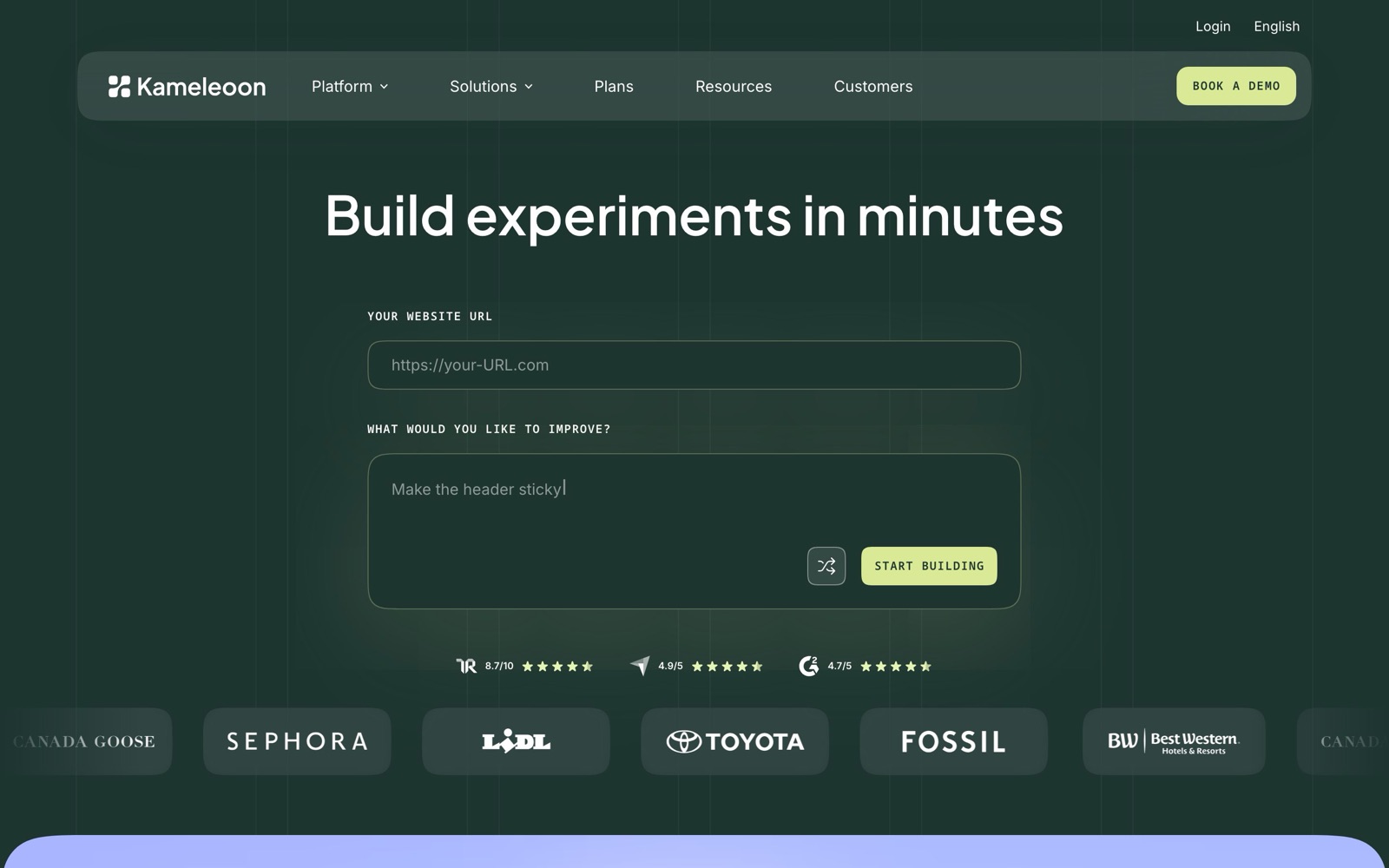
What Kameleoon is: web and feature experimentation with AI targeting
Kameleoon sells three connected products. Web Experimentation covers classic client-side A/B tests.
Kameleoon now leads with what it calls Prompt-Based Experimentation (PBX): you describe a variant in plain language, the tool generates it, and you can still open, edit or hand off the code.
Feature Management adds feature flags, progressive rollouts and feature experiments run through SDKs.
According to the developer docs, server-side SDKs cover Java, C#, PHP, Node.js, Ruby, Python and Go, and client or mobile SDKs cover Android, iOS, JavaScript/TypeScript, Flutter and React/React Native.
Personalization targets visitors by segment, behavior or custom data, and the plan comparison lists contextual bandits and multi-armed bandits for sending traffic to the best-performing experience automatically.
Kameleoon is built for tests that depend on who the visitor is, not just what the page looks like.
A few results from our database show that kind of test:
- One Click ran a country-localized checkout at Readers.com and reported a +30% conversion rate.
- Visually tested a product recommendations slider shown only to returning visitors for Branch: +8.9% conversion rate.
- AB Tasty ran a segment-tailored pop-in for lingering visitors on a North American insurer's landing page: +55.18% kit submits.
Feature experimentation shows up in product and pricing tests that are hard to run with a front-end script.
Server Density's switch from per-server to packaged pricing tiers lifted revenue +114%.
AURUM's floating onboarding checklist in a trial raised activation +187%.
 Visually
Kameleoon pricing
Kameleoon publishes an entry price, which is rare for this tier of tool.
As of November 2026, its plans page lists three options:
- Free: 30 days, no credit card, up to 3 experiments.
- PBX Starter: from $495/month for up to 10 experiments and 50,000 tested visitors a month, on 1 project with unlimited users.
- Custom (Enterprise): unlimited experiments and tested traffic. Pricing is not published, so you have to talk to sales.
Starter includes PBX, sequential testing, 40+ segmentation criteria, holdouts, multiple testing correction, SRM detection and a Figma integration.
Feature management, feature experimentation, personalization, mobile app testing, the JS/CSS code editor, bandits and CUPED are listed as add-ons to Starter.
In practice, the hybrid and full-stack setup this review covers means a custom contract.
Kameleoon also offers two billing models. MUU/MAU bills on monthly unique users, so traffic spikes and pushing 100% of traffic to a winner don't change the price.
MTU bills only on users tracked in campaigns.
Kameleoon says MTU suits high-traffic brands that test selectively, but its own comparison notes that traffic spikes and sending 100% of traffic to a winner can cost you more.
| Plan | Price (as of November 2026) | Limits | Best for |
|---|---|---|---|
| Free | $0 for 30 days | Up to 3 experiments | Trying PBX before buying |
| PBX Starter | From $495/month | 10 experiments, 50,000 MTUs, 1 project | Marketing teams running client-side web tests |
| Enterprise | Unlimited experiments and traffic; EU, US or custom data residency | Teams that need feature flags, personalization, mobile and on-premise options |
Strengths: privacy, EU hosting and hybrid testing
Data residency and compliance. Starter accounts can choose EU or US data residency, and Enterprise adds custom residency plus an on-premise option where you self-host the Kameleoon script (plans page).
Kameleoon's homepage lists ISO 27001 and SOC 2 certification and says the platform is GDPR, CCPA and HIPAA compliant.
For EU retailers, banks, insurers and health brands, that list can decide the purchase on its own.
Hybrid experimentation. Kameleoon's hybrid mode pairs a server-side SDK with the front-end engine.
You deploy variants on the server, while the browser script handles tracking for analytics tools that only work on the front end.
You can also target with client-side data and exclude users from a feature flag if they've already seen a web experiment.
That suits a team where developers ship pricing or onboarding changes in code and marketers analyze them alongside page tests.
Statistics and guardrails. The plan comparison lists frequentist, Bayesian and sequential methods, CUPED, outlier handling, ratio metrics, interaction-effect detection between concurrent tests and five automated health checks, including SRM.
One platform for marketers and developers. A visual and prompt-based builder, a code editor and SDKs sit on the same data.
Teams that would otherwise run one tool for web tests and another for flags can merge both.
Weaknesses
The useful parts cost extra. At $495/month, Starter is a client-side web testing plan with one project and 50,000 MTUs.
Feature flags, personalization, mobile testing and even the code editor are add-ons, so the product the marketing site describes is an enterprise contract with unpublished pricing.
MTU billing can surprise you. By Kameleoon's own description, MTU pricing rises with traffic spikes and when you roll a winner out to everyone. Model your yearly traffic before you sign.
Too much for small sites. A store with a few thousand weekly visitors can't fill 10 concurrent experiments with enough traffic to reach significance.
Our low-traffic testing guide explains why fewer, bolder tests work better there.
Personalization still needs proof. Segment-level wins can be noise.
Clean Commit's homepage tailored to new vs. returning visitors showed +241% CR, but the result was unproven and is logged as flat.
Whatever tool you use, run personalization as a controlled test with a holdout.
Not for: Shopify stores looking for an app-based tester, teams under roughly $500/month in tool budget, and engineering-only teams that only want open-source flags.
Kameleoon alternatives
Kameleoon most often competes with VWO, Optimizely and AB Tasty. Here's when each makes more sense:
- VWO: combines A/B testing with heatmaps and session recordings, so research and testing sit in one tool. A good fit if you want behavior data next to your tests.
- Convert: a privacy-first A/B testing tool that works on Shopify and other sites, aimed at agencies and mid-size teams that want a lower entry point.
- Optimizely: the closest enterprise match for web plus feature experimentation inside a wider content platform. Kameleoon competes on privacy hosting and a published entry price. See Optimizely alternatives.
- AB Tasty: another European platform with strong personalization, often shortlisted against Kameleoon by EU retailers.
- GrowthBook: an open-source option for developer-led teams that mainly want feature flags and experiments in code.
LiftArchive earns a commission if you sign up for VWO or Convert through the links below. We have no affiliate relationship with Kameleoon.
| Tool | Main strength | Best for |
|---|---|---|
| Kameleoon | Web, feature and personalization on EU/US hosting | Privacy-sensitive mid-market and enterprise teams |
| VWO | Testing plus heatmaps and recordings | Teams that want research and testing in one tool |
| Convert | Privacy-first web testing | Agencies and mid-size sites, including Shopify |
| Optimizely | Enterprise web and feature experimentation | Large orgs with content and product teams |
| GrowthBook | Open-source flags and experiments | Developer-led product teams |
For the wider field, see our roundups of A/B testing tools and experimentation platforms, or browse all tests in the database for ideas worth running on whichever tool you pick.