




Wynter is worth paying for if you sell to businesses, have a real budget, and want to know how your homepage, landing page or pricing page reads to your target buyer before you spend traffic on an A/B test.
It is not a fit for consumer brands, small teams, or anyone who needs proof of what lifts conversions: a panel of about 15 people tells you why copy confuses, not which version will win.
This review is based on Wynter's public site, docs and pricing page.
We have not run a Wynter test ourselves.
What Wynter does: message tests with verified B2B panels
Wynter shows your page or copy to people who match your ideal customer profile and collects their written reactions.
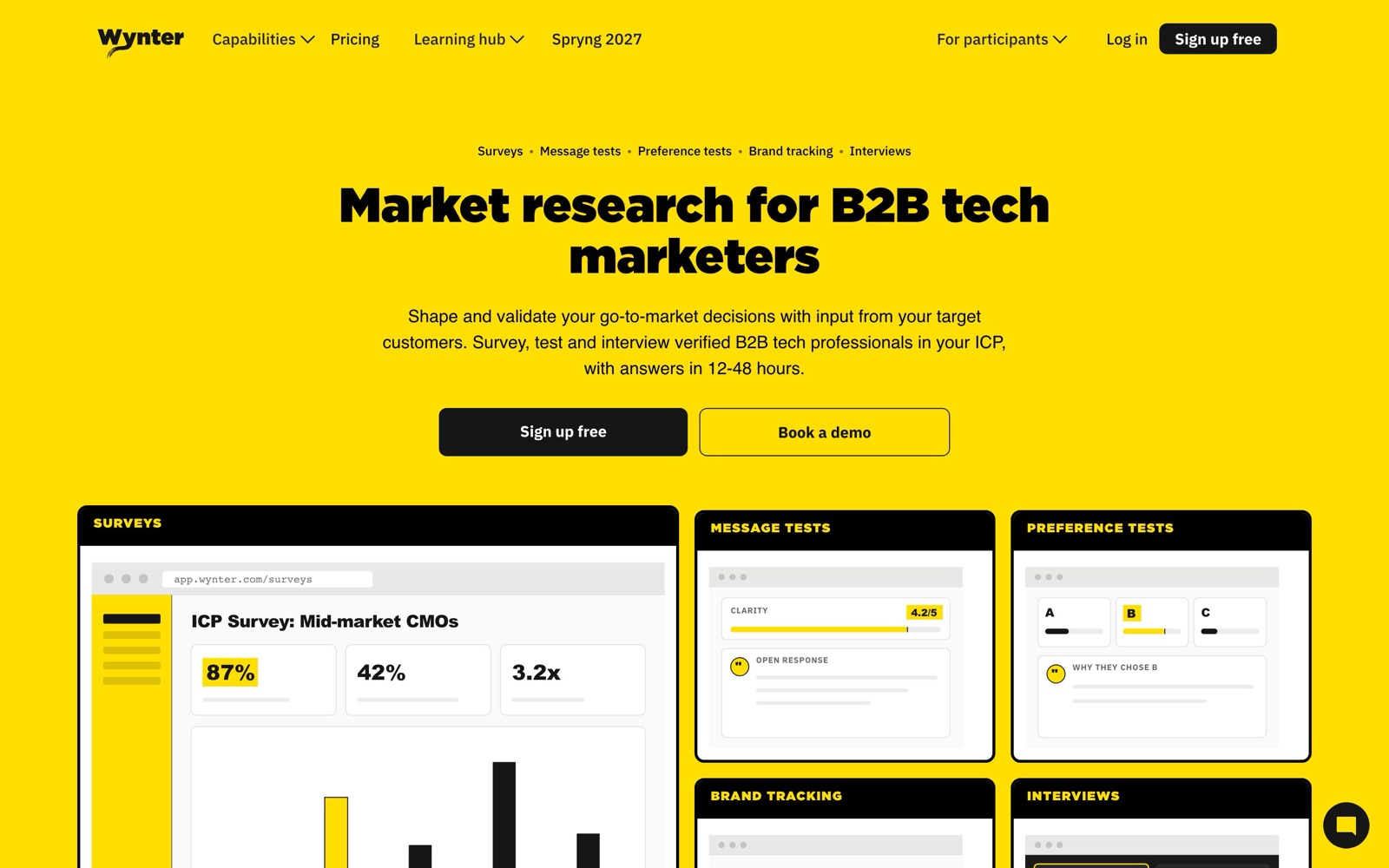
Its homepage lists surveys, message tests, preference tests, brand tracking and interviews, with answers in 12 to 48 hours.
The panel is the product. Wynter says it has 86,000+ verified B2B professionals, each verified via LinkedIn and corporate email, and you can target by role, industry and region (US, Canada, UK and EU).
It also states it uses no synthetic data or AI respondents.
A message test, per Wynter's own guide, checks five things:
- Clarity: do readers get what you sell?
- Relevance: does it match their priorities and problems?
- Value: do they want it?
- Differentiation: why you over the alternatives?
- Brand: does it come across the way you intend?
You also highlight specific sections of the page so respondents comment on them line by line.
Other test types cover value proposition preference tests, cold email tests and B2B market research surveys.
Peep Laja and Wynter's method
Wynter was founded in 2020 as Copytesting and renamed Wynter in 2021, according to the company's fact page.
It is bootstrapped and based in Austin, Texas.
The founder and CEO is Peep Laja. Wynter's bio says Peep Laja founded a portfolio of companies including CXL and Speero, and hosts the How to Win podcast.
That CRO background shows in the method: Wynter treats a sign-up as the effect and messaging as the cause, so it tries to diagnose the message before anyone measures conversions.
The Wynter research playbook sets the sample size rules.
Fifteen respondents is the default, which Wynter calls the qualitative saturation point.
Thirty is the practical maximum; for more data, Wynter suggests running two tests of 15 on different segments.
Wynter pricing
As of November 2026, Wynter's pricing page lists three annual plans plus pay-as-you-go.
Credits map 1:1 to dollars, and what a test costs depends on how senior the audience is and how many respondents you want.
| Plan | Price (as of November 2026) | What you get | Best for |
|---|---|---|---|
| Pay-as-you-go | Tests from $899; about 1.5x Pro pricing | No commitment, instant quote in the app | One-off tests before a launch or redesign |
| Pro | $20,000/year | 20,000 credits | B2B teams testing messaging every month or two |
| Elite | $40,000/year | 27,000 credits, research advisor, private Slack, up to 6 managed projects a year | Teams that want Wynter to run the research |
| Wynter Black | $100,000/year, 2-year contract | 70,000 credits a year plus 10,000 bonus credits, research strategist, reporting | Enterprise marketing and product marketing teams |
The pay-as-you-go starting price comes from Wynter's fact page.
Its homepage puts a typical message test at around $1,000 to $2,000.
No free trial is listed, though Wynter offers a free AI messaging grader and an AI sameness checker.
Wynter has no affiliate program with us, and we don't earn anything if you sign up.
Message test vs A/B test: when each fits
A message test and an A/B test answer different questions.
A message test asks buyers what they understand, believe and want.
An A/B test measures what visitors actually do.
The usual CRO order is research, then a hypothesis, then a test; our customer research guide walks through that loop.
Wynter is strongest at the research step for B2B pages, where copy changes often move results the most.
A few results from our database show the kind of change a message test can surface before you test it live:
- CityCliq tested a plain positioning tagline, "Create a webpage for your business," and got +90% clicks to pricing. That is a clarity problem a panel would likely flag.
- Veeam Software changed link text from "Request a quote" to "Request pricing" and saw +161.66% CTR. Veeam is listed as a Wynter customer, but the test record doesn't say Wynter was involved.
- Orah's homepage with simpler navigation, industry terms and testimonials moved up got +63% demo clicks. It was a bundled change, so the copy's share of the lift isn't isolated.
- CXperts added a "Trial" offer to Spreedly's homepage CTA and got +34% contact form submissions.
Use a message test when you can't A/B test well: low B2B traffic (see A/B testing with low traffic), a new category, or a full rewrite you want to check before launch.
Use an A/B test when you have the traffic and need to know which version converts.
Many teams do both: Wynter to find out why the page underperforms, then an A/B test to confirm the fix.
More B2B examples are on our SaaS homepage and SaaS landing page pages.
Limits: stated preference and panel size
Panel feedback is stated preference. Respondents read your page because they are paid to, not because they are shopping, so what they say they like can differ from what real buyers do on your site. Only live traffic tells you that.
Samples are small by design. Fifteen people is enough to spot recurring confusion, but it is not a statistical sample, so treat a score as a direction, not a verdict.
Other downsides from Wynter's own materials:
- Price: subscriptions start at $20,000 a year, which puts regular use out of reach for many startups.
- B2B only: the panel is professionals, so consumer brands and DTC stores are better served elsewhere.
- Niche audiences: cost rises with seniority, and very narrow roles may be harder or slower to fill.
- No API: Wynter says it has no API, so results don't flow into your other tools automatically.
Wynter is not for ecommerce stores, consumer apps, teams with only a few hundred dollars for research, or anyone who wants a quantitative answer on conversion lift.
Wynter alternatives
If Wynter's price or B2B focus doesn't fit, these cover parts of the same job:
- Lyssna: five-second, preference and first-click tests with its own panel, cheaper and better for consumer audiences. See our Lyssna review.
- UserTesting: video sessions of people using your site, for larger teams. See our UserTesting review.
- Maze: unmoderated tests and surveys aimed at product and design teams. See our Maze review.
- Your own customers: interviews or a survey of current buyers cost nothing but time, and real customers are the strongest signal.
- Ad split tests: running two headlines as paid ads measures behavior from cold traffic, at the cost of your ad spend.
For side-by-side options, see our message testing tools roundup and the wider list of customer research tools.
Verdict
Wynter does one thing well: it puts your B2B messaging in front of verified buyers and tells you, within two days, where it confuses or fails to persuade.
For a funded SaaS team before a launch, rebrand or pricing page change, a $1,000 to $2,000 test is cheap insurance.
For everyone else, the price and the B2B-only panel point to Lyssna, customer interviews or a well-run A/B test instead.